Past Newsletters
Vol3 No 4
In Pursuit of Chocolate
Signature Truffles from the Mountains of Vermont
This month our tantalizing selection of chocolate comes from Green Mountain Chocolates, a world renowned company known for its dedication to the art of making handcrafted chocolates in Vermont. Albert Kumin, a Swiss-trained chocolatier and patissier, founded Green Mountain Chocolates in 1988. Acclaimed for his expertise in the art of chocolate making, Kumin was inducted in the Chocolatier Hall of Fame in 1990.
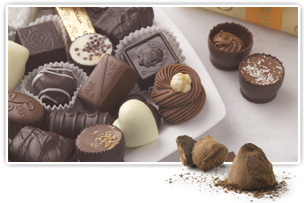
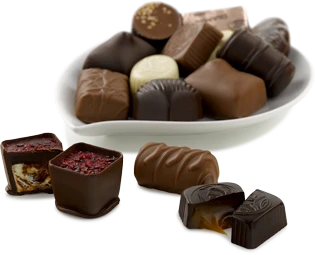
We are pleased to bring you his signature line of truffles - chocolates perfectly balanced between bitter and sweet, with creamy, intensely rich, double-filling centers. All of these sweet bonbons consist of a blending of chocolate, Vermont fresh cream, sweet butter and natural flavorings. Green Mountain Chocolate's premium ingredients and careful packaging ensure extended freshness and a three-month shelf life.
There are 5 different flavors of these hand-rolled truffles with the split personality - each having, unto their own, two incredibly distinct tastes surrounded by chocolate. Ganache is used for half the filling and as the base of the truffle - a sumptuous mixture of equal parts chocolate and cream. It is one of those fabulous combinations where each of the ingredients is enhanced by the other. Ganache is a thick, extremely rich chocolate cream filling that is handmade at Green Mountain Chocolates, pouring hot cream over velvety smooth chocolate chunks then whipping the mixture until the chocolate melts. Natural flavoring and fillings are then added to the other half of the truffle. The jewels are then finished with their own "signature" toppings and coveture.
- Hazelnut - half hazel cream and hazel truffle, rolled in hand roasted hazelnuts.
- Double Chocolate - made with half milk and half dark chocolate ganache, sprinkled with chocolate shavings.
- Amaretto - half almond creme and amaretto truffle, rolled in roasted almonds.
- Raspberry - made with half white raspberry ganache and half dark raspberry ganache, rolled in dark chocolate and sugar.
- Caramel - half caramel ganache and half liquid caramel, hand rolled in milk chocolate.
A Lesson in Swiss Mastery
At age 15, Albert Kumin started his pastry apprenticeship in his native country of Switzerland, developing his craft as chocolatier under the guidance of the Swiss masters. During his international career, Albert has been executive pastry chef at some of the finest resorts and hotels in the world, which included the legendary Four Seasons in New York, and was designated Head Pastry Chef at the White House during the Carter administration. He groomed an entire generation of pastry chefs and chocolatiers during his tenure as Pastry Chef Instructor at the Culinary Institute of America. Founded in 1946, The Culinary Institute of America holds the esteemed position of being the singular residential college in the world devoted completely to culinary education. Starting his company ten years ago with his daughter, Julie, and son-in-law Jeff (graduate from the Culinary Institute of America, 1974), Albert has passed his professionalism
and mastery on to his staff, making Green Mountain Chocolates one of the premier chocolate companies of the world.
Green Mountain Chocolates is an extraordinary group of chocolatiers, dedicated to continuing Albert Kumin's Swiss master legacy as one of the world's finest Swiss chocolatiers. Albert's remarkable devotion to excellence, craftsmanship, mastery and use of the finest ingredients has become GMC's recipe for achieving elegant taste in their velvety smooth chocolates.
- The New York Times has praised Green Mountain Chocolate Truffles as one of the "preferred" three truffles in the U.S.
- Vanity Fair Magazine describes Albert Kumin as a "wizard with chocolate" (August 1999)
- Gourmet Magazine rated our truffles in the top ten in the world (March 2001)
It is said that, ordinarily, the most commonly craved food in all the world is chocolate. Some people even believe that they wouldn't be able to live without it. Theories abound for the reasons behind these intense desires for chocolate, but it is a subject not completely understood.
People who say they are "addicted" to chocolate call themselves "chocoholics." But the factual characteristics of addiction - physiological mechanisms like tolerance and withdrawal, chemical changes in the brain - are not even remotely associated with chocolate consumption. In truth, what most people experience are merely strong desires or cravings for chocolate. Several theories have developed as scientists have studied chocolate cravings over the years, but it seems that it is simply the unique flavor, smell, and texture of chocolate that provide a fulfillment that other foods can't.
Theoretically, there are several bioactive compounds in chocolate contribute to feelings of well-being. These include caffeine and theobromine, which are stimulants; phenylethylamine and tyramine (similar to amphetamine, a central nervous system stimulant); and anandamide, which can act as a cannabinoid mimic. But, all of these compounds are only trace amounts in chocolate and are found in many other commonly consumed foods that are not craved in the way chocolate is.
Researchers have found that cocoa-filled capsules, which contained all of the same compounds as chocolate, did not satisfy these cravings. They have concluded that the immense sensory experience of eating chocolate is necessary part to satisfying the desire. These sensory properties that are associated with chocolate include smooth, melt-in-your-mouth textures and sweet tastes commonly found in chocolates of all kinds.
We have all heard that women yearn for chocolate more than men. In fact, 40 percent of the women in the United States say they frequently crave chocolate before and during menses. This possibly based on the fact that during menstruation a woman's body is usually found to be deficient in some necessary compounds and that the body craves these compounds in an effort to satisfy the deficiency. Magnesium, which is found in chocolate, is one these compounds. But, it is interesting to see that other foods such as lentils and kidney beans are also high in this mineral but are rarely reported as foods commonly craved by women before or during menses. 
Further, potentially neuroactive alkaloids have been identified as compounds in chocolate and cocoa by a researcher in Spain. They are called tetrahydro-beta-carbolines, and are probably produced by heating and fermentation. It is not clear whether they have any biological significance, but because of their possible effects on the nervous system, they might play a role in the strong desires that chocolate is so famous for stirring up. Still, as mentioned earlier, these same compounds are present in many other foods that are not typically craved, such as fruits.
It is also believed that culture may, in part, influence strong chocolate desires. A study of American and Spanish male and female subjects found that, though the frequency of chocolate craving was more than twice as high in American women as in American men, there was no gender difference seen in the Spanish subjects. This might suggest that the desire is not physiological, but more likely cultural.
It is widely believed that the consumption of chocolate provides a unique feeling of euphoria that comes mainly from sensory pleasure. These sensory stimulating properties are the sweet tastes and creamy textures that leave people with a feeling of contentment. Whether it is the gender differences, sensory pleasures, cultural influences or biological reasoning, many theories continue to be associated with strong chocolate desires. Still, it is important to acknowledge that there is no conclusive evidence to date to support the theory that chocolate cravings are pharmacological in nature.
Although the author of the following article is unknown, we here at C&H Clubs thought he probably wasn't alone in his opinions. Fellow husbands read on - and take heart. 
Chocolate is the Creator's subtle way of reminding men how inadequate they are. I am confronted with this fact every time my wife and I go out to eat. My wife usually orders the most chocolate-saturated dessert possible at the end of the meal: The one called "Unstoppable Tripple-Fudge Chocolate Mudslide Blast" or some such thing. I've always wondered why anyone would want to consume anything that promises a catastrophic natural disaster in your mouth.
The sinful brown monstrosity arrives at the table, and my wife takes her first bite. Before the fork is removed from her mouth I hear the familiar small moan escape her lips. Her eyes, previously perfectly focused, first cross slightly and then phase out completely, pupils dilated in pure chocolate pleasure before the eyelids come down in ecstasy. The hand that is not holding the fork clenches into a fist and starts pounding the table rattling the silverware. She finally manages to swallow the bite after about five minutes of this, refocus her eyes, and take the shuttle back from whatever transcendental plane she's been visiting. Slowly, her reign of consciousness expands to also include me - her husband, her lifelong partner, her assumed partner in all things bringing ecstasy. "This is pretty good," she'll say. "You want to try some?"
No, I don't. I don't want anything to do with an object that seems to do to my wife in one bite what I've worked for an entire relationship to achieve. It wouldn't do me any good, anyway. Men just don't have the same rapport with chocolate that women have - not even close. May be silly, but I wandered around the office today and asked the men - "Chocolate. Your thoughts?" - and the result was the same with every one. First, a confused look as to why they're being asked about something so unimportant, then some lame, obvious statement: "Uh...it's brown?" Ask women that same question, and you'll get responses like "The ONLY food group there is," "ESSENTIAL to life as we know it," and the utmost casual swipe to every member of the Y-chromosome brigade, "better than sex." Ouch. Some women will try to make up for that last one by conveniently adding that chocolate is "supposed to be the ultimate aphrodisiac". Uh-huh. Chocolate most certainly increases desire;
problem is the desire is usually for more chocolate. Probably the best a guy can do is buy a box of chocolates and hope he'll be thought of somewhere between the strawberry nougat and the cherry truffle.
But don't get me wrong. Guys like chocolate just fine; it's just not "essential to life as we know it". Respiration is essential to life as we know it; chocolate is simply a nice little bonus. We won't usually pass it up when offered, but I don't know too many guys who would get worked up if it were to suddenly disappear from the face of the earth (ironic in a way, as back in the days of the Aztecs, only men were allowed to have the stuff). When I eat a chocolate dessert, I find pleasure in it, yes. But my world view doesn't narrow to include only the plate that it's on. Maybe guys are missing something. On the other hand, we don't have to pick up our silverware from the floor after we're done with our tiramisu. I think life is about tradeoffs like that. All I know is that come Valentine's Day, chocolate will be among those things I offer my wife. I can't truly appreciate it, but I can appreciate what it does for her. Close enough.