Past Newsletters
Vol. 7 No. 2
DeBas Chocolatier – Guy DeBas - A Story of Life and Death
The story we’re about to tell is of Guy DeBas’ incredible life story. Founder of the respected DeBas Chocolatier, his tale goes beyond the typical chronicle of diligent study and years of dedicated labor honing artisinal craftsmanship—this is a story of life and death. His story is in sharp contrast to the sweet decadence that waits inside each tantalizing truffle you’ve received this month. It begins just outside Beirut in the troubled period of Lebanese history during the mid 1970’s.
From Prosperity to Persecution
The brutal civil war that gripped much of Lebanon from 1975 through 1990 was fought along both religious as well as political borders, pitting, among other groups, Christians and Muslims, Communists and Socialist against each other. Due to the country’s proximity to other middle eastern nations, countries such as Israel, Palestine and Syria found their own motives to get involved with the warring factions of the country, by both financially backing certain groups and/or physically contributing their own troops to battles during the unrest. Truly a geopolitical hotbed during these troubled times, the role of Lebanon in Middle Eastern history has been pivotal, and the DeBas family has played a part from early on. In fact, a great uncle of Guy’s was actually the first president of Lebanon. Like the region itself, however, his family has experienced drastic changes and tragic losses.
Before the turmoil of the mid 1970’s the wealthy DeBas family owned a palatial estate near Beirut. They had plenty of land, a country club, and even owned a large chocolate factory. As Guy himself puts it, “we had everything the world would think you’d have if you ‘had it made.’” Theirs was a family of prominence and a lifestyle of comfort and prestige. It was from these early years of Guy’s life that he gained an admiration for the finer things, including an appreciation of the finest confections available. However, tragedy struck in a terrible accident in Guy’s youth when his mother and one of his brothers were killed in a home gas explosion. Sadly the disaster was a prelude to plight to come.
Some years later in 1976, Guy’s father George, a well known Greek Orthodox countryman was nominated to become president of Lebanon. Not surprisingly, in the religiously and politically charged climate, many were not pleased with the nomination. Soon the family was dealing with death threats, followed by actual assassination attempts. As leverage to pressure his father’s rejection of the nomination, Guy was taken hostage and was held captive for 32 days by the Palestinian Communist Party, during which time he was subjected to severe psychological and physical abuse. Fortunately he was rescued from captivity, oddly enough by The Communist Party of Lebanon, in a dramatic rescue effort and gun battle. The irony that communist sects were shooting one another over the life of a Christian politician’s son was not lost on Guy. His saviors never divulged their true reasons for helping him—it remains a mystery to this very day.
The rescue, however, would not protect him from a subsequent siege. In the time he had been in captivity, the Socialist Party had invaded the family’s land and widespread warfare ensued . One afternoon his home was stormed by Palestinian guerillas and his family, guests and estate staff were rounded up, lined up outside their home, and shot. After the execution, the gunmen left the scene and Guy’s brother, who had been hiding during the siege, came out to find his brother barely alive and critically wounded. Thanks to the efforts of his brother and Guy’s incredible will to live, he survived the 3 hour journey to the hospital. Upon arrival, doctors took a look at Guy and, believing him to be dead, advised his brother to get him out of the hospital and take him to the morgue, to which Guy mustered up the strength to retort, “Wait. I’m still here.” Though Guy was shot 22 times, he survived the attack. Sadly, his father and many others were not so lucky. “Almost 20 people died that day,” DeBas says upon recounting the terrifying ordeal.
A Second Chance at Life, and a New Beginning
In 1978, shortly after his recovery in Sweden, DeBas moved to California and attended Cypress College in Orange County in order to continue his studies of agriculture. There he met his wife, Wendy, and the couple moved to Fresno, where DeBas completed his degree at Fresno State University. When his brother in Lebanon discovered their father owned part of a chocolate factory now left to his children, the family called on Guy DeBas to come back home and make something out of the business.
DeBas and his wife traveled back and forth between the United States and Lebanon for two years. During this time, DeBas was building a second fortune exporting coffee and honey and importing chocolate. However, this second round of DeBas’ prosperity was not to last. Within mere months of one another, his new Madera home was destroyed by fire and the chocolate factory was leveled by terrorists in Lebanon. Not willing to give up on chocolate entirely, the couple set up a new business in the United States and started from scratch. DeBas and his wife began making chocolate in their home.
After a friend decided to invest in the business, they moved into a 1,000-square-foot retail site. The friend eventually asked to be bought out of what would unfortunately become a struggling business. DeBas imposed a deadline on the business’ success, vowing to close up shop if things didn’t improve. His self-imposed deadline was mere days away when in 1986 he attended the International Gourmet Show in San Francisco. With literally 2 truffles on hand, DeBas struck gold at the show—landing a lucrative $35,000 contract with Trader Joe’s for 100,000 truffles. It would be the day his luck changed—seemingly permanently. Guy DeBas hasn't looked back since.
You Can’t Keep A Good Chocolatier Down!
Today, DeBas Chocolatier is recognized as a worldwide leader of gourmet chocolates with sales of over $4 million annually. They have always sought to expand and improve their product line, currently boasting an impressive variety of fine chocolate delights, including candy bars, truffles, chocolate-covered coffee beans, chocolate-covered candied orange peels, and chocolate dipped fruits and nuts, among others. Its line of wine-filled chocolates—cabernet sauvignon, chardonnay and merlot—is among the company's most exclusive, popular and unique designer items.
The Best Yields Success
According to DeBas, the key to his success lies in producing the best gourmet chocolates on the market and continually coming up with new ideas. “If somebody comes to me and says, ‘I’ve tasted a better chocolate,’ I will work harder” DeBas says. “And to be competitive, you always have to come up with something new.” The company has consistently maintained a staunch determination to keep the quality of their products as high as possible. In the recession of the late 80’s and early 90’s, while other chocolate makers were switching to cheaper recipe alternatives, DeBas enhanced the quality of his creations by using higher grade, more expensive ingredients and more elaborate designer packaging. In doing so, DeBas further developed his respected reputation for producing the finest gourmet chocolates available and effectively set himself apart from the competition. These delicacies are not the sort shoppers will find on supermarket counters. DeBas items are found in boutiques or fancy gift baskets sold in high-end markets.
We’re happy to report that their commitment has paid off; in the late 1990’s, the company reached a milestone: DeBas Chocolatier moved from a cramped 3,000-square-foot site to a 15,000-square-foot factory. Guy DeBas credited the city of Fresno with helping him find a site to build the factory where workers produce 5,000 pounds of chocolate each day. These days Guy admits to regularly eating 1 ½ pounds of those 5,000 made each day—an indulgence he’s certainly earned. On overcoming his many obstacles, most importantly the attempt made on his life, DeBas says "God kept me alive so I can sweeten the world." And sweeten it he has—quite literally.
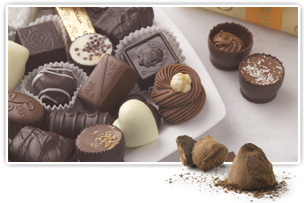
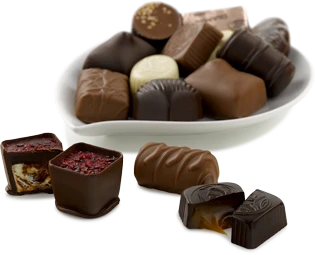
To this day every piece of DeBas chocolate is crafted by DeBas artisans. Each a true work of art, they’re all are distinctly superior in quality and taste. Vibrant colors, delicious European chocolates, and an assortment of sumptuous gourmet fillings characterize this particular mélange of strikingly attractive fine truffles. As soon as you open the box, you’ll notice how gorgeous these fine treats really are, presenting a beautiful juxtaposition of deep chocolate tones and seductively colored decorative dressings. You’re surely enjoy our selections from a line of over 35 different styles of signature truffles from the DeBas factory. They include espresso, Gran-Marnier, Irish Cream, milk chocolate, peanut butter, raspberry, cappuccino, champagne, Cognac, Crème de Menthe, dark chocolate and English toffee.
A Brief History of the Treasure We Call the Truffle
Have you ever wondered how someone could come up with such a scrumptious concoction as the truffle? Being that the term "truffles" has actually referred to underground mushroom-like fungi far longer than chocolate confections, one wonders how the bridge from tasty mushroom to intoxicating delicacy occurred.
Mold truffles have been mentioned in historical texts as far back as the Bible and have been a delight much sought after through the ages in many cultures. In recent years, during the first Persian Gulf War, some Kuwaitis were more upset over the loss of truffles than they were the ransacking of their country.
With the discovery of the New World, many new foods and cooking techniques came to be. One of these was none other than chocolate, quickly becoming the rage of its day. During this same time, ground truffles were still only available to those lucky enough to find them or with the wealth to buy them. It was a very ingenious person who discovered that a ground truffle could be preserved for some time in either brandy or port, with the liquors absorbing some of the truffle aromas, essences and esters. Chocolate shells were then created, into which small quantities of this liquid were poured, and then sealed with a bit more chocolate. Suddenly the taste and aromas of both truffles and chocolate could be enjoyed together and a new luxury for a new world came to be! These days, truffles are among the most popular of all chocolate based treats. The many savory fillings in truffles are astounding both in number and flavor and are limited only by the imaginations of those inventive minds that create them. The samples we’ve culled from DeBas are among our favorites, and we believe that you’ll enjoy them as much as we did!