The Gourmet Chocolate of the Month Club

Past Newsletters
Vol 5 No 6

In Pursuit of Chocolate

Claudia B Truffles

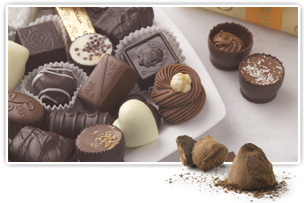
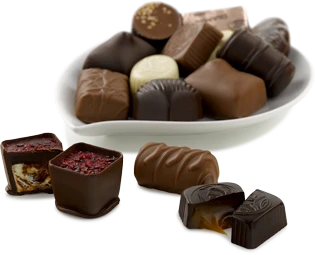
Our Truffles are our most elegant chocolates pieces. Each is handmade with fresh whipping cream, pure butter, smooth creamy chocolate and all-natural flavorings.


Cafe Mocha-Milk chocolate center flavored with mocha coffee with milk chocolate outside


Irish Cream-Dark chocolate center blended with Irish Cream with a dark chocolate outside


Black Forest-Dark chocolate center flavored with kirsch with a dark chocolate outside


Raspberry Mousse-Dark chocolate center blended with a raspberry compound with a dark chocolate outside


ChocolateHazelnut Mousse-Rich milk chocolate mousse center with a nutty flavor with a milk chocolate outside


Grand Marnier-Dark chocolate center blended with Grand Marnier with a dark chocolate outside


Company Profile

Claudia B Chocolates was started in October of 1987 in San Antonio, Texas. The business started as a retail store in the fashionable mall in San Antonio known as North Star Mall. At that time, the store was known as Le Chocolatier. In a short period of time, the operation was expanded to other retail locations selling products that were produced in the original location. In 1989, a production facility was established outside the retail location in order to satisfy the demand for the product from other retailers that wanted the product in their retail stores. In the summer of 1996, we move to our current location..

Claudia B Chocolates is shipped into all states, mainly to candy, specialty gourmet, coffee, and gift stores. You might also find some of our products on your pillow at night in your favorite hotel.

All of our products are handmade in small batches, thus insuring the freshness. Only fresh cream, butters and natural compounds are used in the preparation of our products.


Truffles 101

The History of the Truffle

Did you ever wonder how someone could come up with such a scrumptious concoction as the truffle? Being that the term "truffles" has referred to underground fungi far longer than chocolate confections, one wonders how the bridge from tasty mushroom to intoxicating divinity occurred.

Mold truffles have been mentioned as far back as the Bible and have been a delicacy much sought after through the ages in many cultures. In recent years, during the Kuwait War, some Kuwaitis were more upset over the loss of truffles than they were the ransacking of their country.

With the discovery of the New World, many new foods and cooking techniques came to be. One of these was none other than chocolate, quickly becoming the rage of its day. During this same time, ground truffles were still only available to those lucky enough to find them or with the wealth to buy them. It was a very ingenious person who discovered that a truffle could be preserved for some time in brandy or port, the liquors absorbing some of the truffle aromas, essences and esters. Chocolate shells were then created, into which small quantities of this liquid were poured, and then sealed with a bit of chocolate. Suddenly the taste and aromas of both truffles and chocolate could be enjoyed together and a new luxury for a new world came to be!

Understanding Chocolate Cravings

It is said that, ordinarily, the most commonly craved food in the entire world is chocolate. Some people even believe that they wouldn't be able to live without it. Theories abound for the reasons behind these intense desires for chocolate, but it is a subject not completely understood.

People who say they are "addicted" to chocolate call themselves "chocoholics." But the factual characteristics of addiction - physiological mechanisms like tolerance and withdrawal, chemical changes in the brain - are not even remotely associated with chocolate consumption. In truth, what most people experience are merely strong desires or cravings for chocolate. Several theories have developed as scientists have studied chocolate cravings over the years, but it seems that it is simply the unique flavor, smell, and texture of chocolate that provide a fulfillment that other foods can't.

Theoretically, there are several bioactive compounds in chocolate contribute to feelings of well-being. These include caffeine and theobromine, which are stimulants; phenylethylamine and tyramine (similar to amphetamine, a central nervous system stimulant); and anandamide, which can act as a cannabinoid mimic. But, all of these compounds are only trace amounts in chocolate and are found in many other commonly consumed foods that are not craved in the way chocolate is.

Researchers have found that cocoa-filled capsules, which contained all of the same compounds as chocolate, did not satisfy these cravings. They have concluded that the immense sensory experience of eating chocolate is necessary part to satisfying the desire. These sensory properties that are associated with chocolate include smooth, melt-in-your-mouth textures and sweet tastes commonly found in chocolates of all kinds.

We have all heard that women yearn for chocolate more than men. In fact, 40 percent of the women in the United States say they frequently crave chocolate before and during menses. This possibly based on the fact that during menstruation a woman's body is usually found to be deficient in some necessary compounds and that the body craves these compounds in an effort to satisfy the deficiency. Magnesium, which is found in chocolate, is one these compounds. But, it is interesting to see that other foods such as lentils and kidney beans are also high in this mineral but are rarely reported as foods commonly craved by women before or during menses.

Further, potentially neuroactive alkaloids have been identified as compounds in chocolate and cocoa by a researcher in Spain. They are called tetrahydro-beta-carbolines, and are probably produced by heating and fermentation. It is not clear whether they have any biological significance, but because of their possible effects on the nervous system, they might play a role in the strong desires that chocolate is so famous for stirring up. Still, as mentioned earlier, these same compounds are present in many other foods that are not typically craved, such as fruits.

It is also believed that culture may, in part, influence strong chocolate desires. A study of American and Spanish male and female subjects found that, though the frequency of chocolate craving was more than twice as high in American women as in American men, there was no gender difference seen in the Spanish subjects. This might suggest that the desire is not physiological, but more likely cultural.

It is widely believed that the consumption of chocolate provides a unique feeling of euphoria that comes mainly from sensory pleasure. These sensory stimulating properties are the sweet tastes and creamy textures that leave people with a feeling of contentment. Whether it is the gender differences, sensory pleasures, cultural influences or biological reasoning, many theories continue to be associated with strong chocolate desires. Still, it is important to acknowledge that there is no conclusive evidence to date to support the theory that chocolate cravings are pharmacological in nature.

Logo
Since 1994
Home
Join our Club
Gift Memberships
Renewals
Chocolate Club Info
Club Q&A
Current Chocolate Selections
Past Club Selections
Testimonials
Other Gourmet Clubs
Corporate Gifts
Wedding Gifts
Chocolate Bytes
Chocolate Recipes
Resources
Ask Jude
Print a Gift Card
Send a Virtual Treat
Refer a Friend
Send a Hint
E-Promos
Contact Us
Link to Us

1 - 800 - 625 - 8238
(Outside US call: 949-206-1904)
P.O. Box 1627, Lake Forest, CA 9260