Past Newsletters
Vol 5 No 11
In Pursuit of Chocolate
Belgian Chocolate—You Can NEVER Have Enough!
OK, you got us. Last month we featured a Belgian chocolatier and even though
we pride ourselves on variety—we’re featuring the work of another
band of Belgian-born chocolate savants. Not to say that these chocolates aren’t
different from last month’s—they are indeed. And even though the
chocolate is Belgian, the producers are Belgian, and the chocolate making traditions
used to create this month’s featured treats are authentically Belgian,
the range of cocoa-based offerings from this wonderful nation could easily
provide us with enough variety to actually start our own “In Pursuit
of Belgian Chocolate Club.” While we’re not about to go that far,
this month we were presented with a special opportunity that we just had to
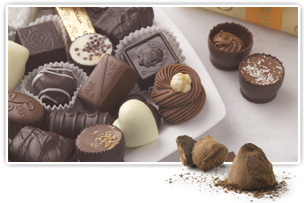
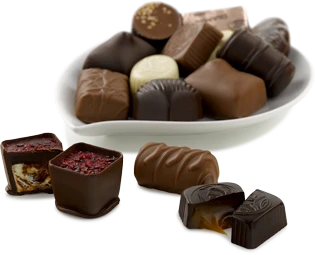
take. When we discovered that we could get our hands on the 1-lb. Galler Praline
Ballotin, a product that to our knowledge had yet to ever be shipped to the
states, we made our phone calls, pleaded with our vendors, called in a few
favors and procured an amazing collection of Pralines that we’re absolutely
certain will astound your senses and please your palate!
Shipped Directly from Belgium, Previously Unavailable in the States!!
Galler is a family business founded in 1976 by Pierre and Jean Galler, well known, distinguished, gifted craftsmen of the chocolate trade. And while the company has grown tremendously in their nearly 29 year history, the foundations of the company remain unchanged; uncompromising passion for chocolate, utmost pride in perfection and the cultivation of constant creativity are attributes the company commits to very seriously. Their team of 75 personnel design, produce and market filled-chocolate bars, as well as chocolate tablets, pralines, cat’s tongues (cartoonish-looking cats molded from pure chocolate chocolate), ice-cream, spreads, chocolate patisseries, chocolate eggs, pralines and literally tons of other indulgences. In their three decades of creating, they have amassed a mind boggling assortment of delectable edibles. We literally spent hours on their website just trying to take it all in! But when you’re a bunch of chocoholics like us, there’s no such thing as tiring of the stuff (though, admittedly, reading about these sinful treasures without getting to sample any of them was a fairly torturous task… we’re gluttons for punishment sometimes… but we digress…)
The World Has Definitely Taken Notice!
After having built a respected reputation
in its originally diminutive Belgian locales, Galler is now found throughout
the Belgian market, playing an ever
larger role in chocolate-based commerce, with a reputation and product demand
grand enough to support a presence in all the large-scale distribution networks
in the country. In Belgium alone there are more than 2,000 sales outlets
and the network of Galler stores currently stands at more than 17: Vaux-sous-Chèvremont,
Liège, la Grand'Place, Wavre, Uccle, Jette, Waterloo, Malines, Ixelles,
Brugge, Ciney, Verviers in Brussels (to name a few); Belle Etoile and Cora
Foetz in the Grand Duchy of Luxembourg; and in various locations in France
and Japan. Of particular interest are a series of three Belgian salons based
on a unique concept shop called “Chocolat-Thé” where Galler
chocolates and teas come together in a warm and friendly environment meant
to evoke the calm, nurturing, practically sacrosanct peacefulness characteristic
of visits to Grandma’s as a child. As Jean Galler himself describes
it, “I imagined a place reminiscent of my childhood, tea-time at my
grandmother’s, the air filled with the sweet scent of pie fresh from
the oven. A place to see and find out everything about chocolate, a place
where all its range of tastes, from restrained to unbelievable, can be discovered.
Finally, a place where there is the ability to create, to dare and to share
chocolate cuisine. From my chocolate-inspired dream, Chocolat-Thé was
born.” And in case you can’t make it out to one of these international
shops, as of November 2003 Galler has a new domestic home in the USA, located
in Boca Raton, Florida! For a complete listing of all of their shops, including
their “Chocolat-Thé” salons, please visit their website
at http://www.galler.com.
Beautiful Ballotin Bliss!
The following paragraph is excerpted from the Oxford Companion to Food, by Alan Davidson [Oxford University Press:Oxford] 1999.
Ahh, the praline, a chocolate pleasure coveted the world over. A combination of almonds and boiled sugar, it is a popular confection with a long history. The name is originally French, and the Dictionnarie de l'epicerie (1898) specifically states that pralines are made of almonds which are whole and separate, each covered with boiled, grained sugar. This remains the primary meaning of the word in modern French. According to popular legend dating back to at least the end of the 18th century, the name praline is derived from the Duke of Plessis-Praslin (1589-1675). His cook is supposed to have invented a method for coating whole almonds in grained caramelized sugar, and later to have retired in order to produce the sweets commercially. Whatever the truth, pralines were well known, outside as well as inside France, but in the 18th century, recipes for “Prawlins,” or for “Almonds Crisped” began appearing in English cookery books. Borella (1770) observed that “praline” is French Anglicized, as there is no English word to express the real idea of the French in this sort of preserving of almonds. Eventually, however, praline, like many other French culinary terms, became an adopted word in the English language. As an English word, praline now has the main meaning of a powdered nut-and-sugar confection, the nuts commonly (but not exclusively) used being almonds. In North America pralines are a specialty of several southern states. In Louisiana, especially New Orleans, the name applies to candies made with pecans in a coating of brown sugar which used to be sold by Creole women known as pralinieres.
Despite different
variations between pralines from around the world, one thing is for certain.
The pralines from Galler are absolutely beautiful!
But with their delicate beauty comes a particular concern—their fragility.
As the popularity of the praline extended beyond walking distance of local
chocolatiers, transportation of these fine goodies became a popular, albeit
challenging practice (they often fractured or were otherwise damaged). That
all changed when in 1912 Louise Agostini, wife of the grandson of the founder
of Neuhaus Chocolates created the “Ballotin” (the French word
for a small, elegant box of chocolates designed to prevent the chocolates
from damaging each other).
The Galler Ballotin you now have before you, besides being an honor for us to ship, was so very aesthetically pleasing to us. And we’re sure you’ll agree that its artful appearance sings in perfect harmony with the pulchritudinous pralines it houses—creating a packaging worthy of ensconcing such culinary treasures! And not only is it attractive—it’s functional—the easy-opening (you only have to pull the ribbon) lets you discover the choice of pralines elegantly arranged on easy to handle trays, allowing you, the gourmet, to navigate your way through the different layers without knocking over the chocolates. Savor all of them, but let us point out one important fact: each of these tasty treats is made with fresh cream, and as a consequence has a shelf life of about 6 weeks. This means that you will have about four weeks from the time they arrive to eat them because we are air-shipping them directly from Belgium. Somehow though, we have a feeling that this won’t represent too daunting a challenge. Enjoy!
How Should Chocolate Be Tasted and Savored?
Solid chocolates and filled chocolates
represent entirely different culinary philosophies, and thus should not be
savored in the same way. Solid chocolate
should be taken in small pieces, put on the tongue and left to melt. This
allows, on the one hand, for the taster to see if the flavors release themselves
naturally and in a well-balanced, complex manner, and on the other hand,
to see if it really melts; if the chocolate is not “balanced,” for
example, if there is not enough cocoa butter, then it will not melt. Afterwards,
the chocolate should be lightly passed between the tongue and the palate
to ascertain if it has been sufficiently ground to give a fine texture (the
palate and the tongue can feel from 60 microns, but no finer). In Belgium,
chocolate is ground down to 30, even 20 microns to be certain that no grains
can be felt.
In contrast, a filled chocolate should be bitten into several times, so that
the chocolate shell is mixed with the interior filling, thus making it possible
to appreciate the balance that the chocolate-maker has tried to create.
A Poem and a Praline…
We leave you with a short poem that was inspired by the life’s work of the magnificent Galler family.
And if poetry was chocolate
That the ears tasted
Savored
All day and night
In the music of the voice
And if poetry was so good to say
To repeat, to hear, to whisper low
In the evening or at midnight
At midnight even sometimes
Leaving in one’s mouth
The melting chocolate
With fine fresh coffee
So fresh that it is green
Well!
If poetry was chocolate
Me,
I would call it “Galler”.
-Julos Beaucarne, Tourines-la-Grosse, April 22nd, 1992, "manifeste du
goûteur gourmand."