Past Newsletters
Vol 4 No 5
In Pursuit of Chocolate
Another Reason To Savor Each And Every Day
As if we needed one!
The
awe inspiring chocolatier that we have chosen this month is none other
than Nirvana Chocolates. Three years ago Christophe Van Riet embarked
on a quest to find truly fresh chocolates in the United States' those
equal to the quality of chocolates found only in Belgium. His desire
to emulate Belgian chocolates was so strong that he finally realized
he had no other choice but to import exceptional, fresh chocolates
from Belgium. The delicacies you are about to taste come from a small
shop that uses centuries old Belgian methods and only the freshest
ingredients. These outstanding chocolatiers take great pride in crafting
their artisanal chocolates... each morsel is made with passion and
commitment.
The
chocolate shop is located in Brugge, a romantic city where the selection
of fine chocolate is taken very seriously. Check it out at http://www.visit-bruges.com.
The medieval city Brugge is so well preserved that it has several
places that are recognized by UNESCO as world heritage sites.
The foundation of Nirvana chocolates is rich cacao beans from Africa'
they are much stronger and more assertive than the milder South American
beans favored by most American chocolatiers. Add to that cream, butter,
sweetness, and a skillful contrast of textures and natural flavorings,
and you have the basis upon which all Nirvana Chocolates are made.
With eight tantalizing varieties you are bound to experience a bravura
celebration for your senses!
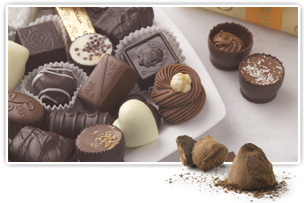
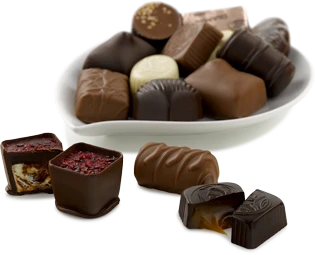
- Cointreau - Milk Chocolate shell filled with delicate creamy Cointreau ganache filling.
- Raspberry - Dark Chocolate enrobing a silky raspberry cream ganache.
- Classic Praline - Hazelnut with chocolate, a classic indulgence' and sooo smoothly complemented by exquisite milk chocolate! FYI: great milk chocolate is hard to come by.
- Caramel - Milk Chocolate filled with a smooth caramel ganache.
- Champagne - White chocolate filled with a luxurious champagne ganache. Is white chocolate really chocolate? Check out our website to find out.
- Amaretto Cream - Dark Chocolate truffle dusted with cacao and filled with amaretto cream.
- Praline Chocolate ' Bresilienne' truly a delicacy! To make it you must first roast and then caramelize hazelnut pieces, and then cover your truffle mixture with varieties of the most pure chocolate.
- Soft Mocha ' Milk Chocolate filled with a soft mocha cream and covered with dark chocolate flakes. What could be better?
In case you weren't sure what a ganache is' Nirvana describes it as the highest percentage of cacao solids, combined with heavy cream and a variety of flavors. The result is a harmonious balance between the smoothness of the flavor texture, and the intensity of the chocolate.
Nirvana
Accolades
Nirvana continues to receive countless testaments and much admiration for their dedication to providing the freshest Belgium chocolate. Here's just a sampling.
'Nirvana Chocolates are emphatically, authentically Belgian' based on recipes centuries-old, and manufactured with the fines ingredients and most meticulous methods.' Chocolatier magazine, 'The Inside Story.'
'A source of excellent Belgian Chocolates. New York Times, "Food Stuff" by Florence Fabricant.
'These exquisite chocolates made with fresh cream and butter, are flown in weekly from Brussels. The butter creams are fabulous, and so are the pralines, and giandujas. San Diego Tribune, selected as "Chocolate of Choice."
Columbus Missed The Boat
So 'they' say, when Christopher Columbus first visited the New World, he encountered many novel foods' potatoes, tomatoes, and corn were at the top of his list. Now really truly think about that! A few hundred years ago, most of the world's cultures had never tasted a potato, a tomato, or corn! Can you image Ireland without potatoes? Italians without spaghetti sauce?! And without corn - no filet minion, and much worse than that - no easy way out of our energy crisis. (Bet you didn't know that one ton of hard coal has an energy equivalent of 3,360 ears of corn! Check out http://energy.cas.psu.edu/EnergySelector/cornequiv.html.)
Amidst these wondrous vegetables, Chris missed the fact that cocoa beans were even a food. He noted in his log that cacao beans were used as coins amongst the Guanache Indians, but not that they were consumed in any fashion. Nobody's perfect. Can you imagine what his life would have been like had he brought back chocolate - a food that was celebrated as an aphrodisiac!
Side Bar: Potatoes originated in the Peruvian and Bolivian Andes of South America and were cultivated thousands of years before European explorations. Around 1570, potatoes were first cultivated in Spain, and 20 years later in England. In the early 1600s they were first introduced to North America.
As best we can tell, the tomato found its' way across the Atlantic shortly after Cortez conquered the Aztec city of Tenochtitlan in 1521. European literature first mentions tomatoes in 1544, and the first cookbook to mention tomatoes was written in Naples in 1692.
A
Chunk of Chocolate History
It took another explorer from Spain, Hernando Cortez, who liked to hang out with the tribal leaders to recognize chocolate's potential. Cortez and his men were fascinated by Montezuma's custom of drinking 'xocalatl,' made by whisking together crushed cocoa beans and cold water.
This bitter, unsweetened chocolate was consumed several times a day, from special solid gold beakers which were destroyed after one drink. If the high priests had any say, they may have tossed them into a volcano; but if the tribal bean counters prevailed, they probably just smelted them down, made new ones, and inflated the price. Of course, only the leaders were allowed to drink it, since it was widely accepted that chocolate gave them special powers. One account states that Montezuma consumed as many as 50 chocolate drinks a day, so we know he definitely had good reasons to think chocolate had magic powers.
Quickly
recognized as a stimulant, chocolate won favor in Spain as a complement
to breakfast. In order to add some character and to make the bitter
flavor more palatable, the wealthy added vanilla, chili powder, and/or
honey. Creativity took over, and boiling water instead of cold water
took the drink to the next step. Ginger, cinnamon or nutmeg was used
for seasoning' sort of like Starbucks. Occasionally, cane sugar was
used, but generally the drink was consumed unsweetened. The Spanish
held this concoction in high esteem, and competition being what it
is, they had no intension of exporting it to other areas of Europe.
For over a century, they kept it to themselves!
The next breakthrough occurred in 1615, when the Spanish Infanta, the eldest daughter of Philip of Spain, married Louis XIII of France. He was fourteen and had inherited the throne after Pops was assassinated. Here she was marrying this guy whom she couldn't even talk to' and word had it that intermarrying had created just a few distasteful problems for poor little Louie. Ah, but for the sake of politics, and the lack of women's rights, she trudged off to do Daddy's bidding' but not without at least bringing her chocolate. Well you all know what must have followed. If it's the Queen's special treat, than the court succumbed!
We can also thank Italian explorers for generously sharing this magic potion. When Italian explorers went to the West Indies in 1600, they also encountered the cocoa bean, and all of its incredulity. Based on what we know today about the different varieties of the cocoa bean, the Italian chocolate experience, no doubt, had different properties.
Chocolate for the Masses
When England took over the island of Jamaica from Spain in 1655, they began to import cacao directly, and cutting out the middleman helped to bring the delights of chocolate to the average Joe. Vienna could boast of the first chocolate house, but London soon followed. By 1657, numerous chocolate houses existed in England. We are told that the English believed chocolate to be a sure-fire hangover cure. Chocolate Shops were very popular with those creative and well traveled types, as well as intellectual and political figures that spent hours debating the relationships between nationalism, freedom, and religion.
By
the end of the 1600s, hot cacao in its 'modern form' - mixed with
hot milk and sugar was the most popular chocolate drink, although
the odd mixes including pepper and mustard were still in existence.
Soon after, chocolate gained favor as a confection, and ceased to
be thought of as just a drink or a spice.
In 1728 the first chocolate factory, for the purpose of making chocolate candy, was built in London. Other countries followed suit, all taking advantage of industrialization in order to create a product that was inexpensive enough for at least the middle class to purchase on a regular basis.
Famous names in chocolate begin to spring up around the beginning of the 1800s'van Houten, Cadbury, Cailler, Nestle, and Hershey. Milton Hershey opened a candy store in 1876 in Philadelphia, which failed after six years. Moving to Lancaster, Pennsylvania, Hershey created a recipe for milk caramels that kept him in business, but focused his energy on creating chocolate recipes to make a chocolate bars. Now there's a very important lesson for all of you entrepreneurs.
For Only the Wealthy in 2050?
According to the polls, nine out of ten people adore chocolate, and the tenth one is lying! But you chocolate lovers better get on board with some ecology groups' AND FAST! The future of chocolate is in jeopardy.
According to Jinn of Quality and Risk 'high prices in the late 1970s and early 1980s stimulated a significant expansion in plantings in Africa, Latin America and Asia. Yet subsequent price declines limited the ability of these farmers to effectively care for the cocoa trees and still make a living. The result has been the widespread loss of whole cocoa-planting regions to low prices, pests and fungal diseases (black pod rot, frosty pod rot, and witches' broom). Today, only three countries - Ivory Coast, Ghana and Indonesia - account for the lion's share of world cocoa supplies.'
The U.S. Department of Agriculture says all the world's major cocoa bean producing regions "are facing serious disease and pest problems." Scientists are working to find a cure for diseases and pests that have already destroyed a third of the world's annual cocoa bean crop and are threatening to spread, with devastating consequences. If the crop continues to fail in 2003 and beyond, a shortfall is forecast, and chocolate prices will continue to go up and up.
We urge you to be informed about our global environment and to be
responsible for the future of our progeny. You might start by reading
the August 26th issue of TIME. We aren't endorsing all of the information,
but it's a great place to start your own personal assessment of our
tenuous life on Earth. Check out the magazine on TIME's website http://www.time.com/time/magazine/0,9263,1101020826,00.html.
Mother Earth needs us all to be vigilant' but then again Earth will
survive once she throws us to the wind. The more poignant assessment
is will the human race survive?