Past
Newsletters
Vol 4 No 1
In Pursuit of Chocolate
To Fresh Beginnings and Royal Flavors
To
help kick start your taste buds and 2003, In Pursuit of Chocolate
brings you an assortment of chocolates fit for royalty. When Alexandra
and Nicolay Mazhirov left their small chocolate factory in Odessa,
Russia in 1992, to move to New York, they brought with them recipes
for creating luxurious Russian materpieces. These recipes, dating
back to the court of the last Czar and Czarina (coincidently named
Nicolay and Alexandra), are made today using Belgian chocolate. It's
blended to be dark, rich, and creamy, and flavored as it was in the
sumptuous days of the court of the Romanov Dynasty.
What
is Russian-style chocolate? Mrs. Mazhirov uses Callebaut chocolate
for dipping succulent apricots stuffed with almonds (called fruits
of the czars), to coat honeyed dried fruit and nut mixtures soaked
in brandy (gold-leaf clusters) and to cover layers of praline and
biscuit wafers (Rasputin`s wafers). She makes truffles, some shaped
like peasant women in babushkas (breakfast of the czars). Others are
stamped with imperial seals or coated with chopped chocolate (Anastasia's
delight).
The American Dream
Alexandra
Mazhirov earned her degree in chocolatology (possibly the greatest
major in the history of higher education) from the Institute of Chocolate
Technology in Odessa, Russia. While studying in Russia, Alexandra
stumbled upon the lost chocolate recipes of the Romanov Dynasty. Knowing
the joy these luscious delicacies brought to so many of history's
most indulgent personalities, Alexandra was determined to perfect
the recipes once again and make them available for all to enjoy. Hence,
the Mazhirovs packed their belongings and headed for the land of opportunity,
Brooklyn, New York.
In the court of Russia's last Czar, it was completely unacceptable to prepare anything with artificial ingredients. And the Mazhirovs uphold that tradition. Each individually handcrafted chocolate is made with only natural ingredients to ensure an experience that your taste buds will not forget.
This
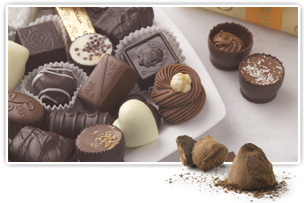
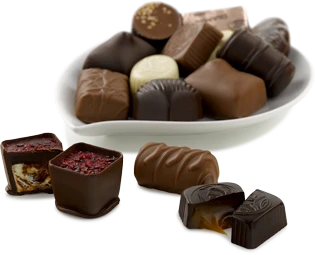
month's signature assortment contains a variety of chocolates in milk,
white or dark chocolate, including; creamy truffles coated in chocolate,
delectable fruits soaked in a special syrup then drenched in chocolate,
and a special blend of hazelnuts and honey enrobed in chocolate. The
chocolates are packaged in silver tins, wrapped in a parchment label,
sealed with a ribbon, and accented with a gold imperial seal.
The Mazhirovs commitment to providing only the finest quality chocolates,
will surely satisfy the Czar and Czarina in all of us!
Choose Chocolate Wisely
The
difference between great chocolate and what you see in most stores
is like the difference between a great hearth baked bread and the
spongy white stuff. Great chocolate is about flavors. And there's
a whole host of factors that influence flavors, some easy to spot,
some not. The very basic guidelines include…
Better Cacao Beans: The best chocolates start with Criollo or Trinatario cacao beans. Criollo beans are hard to grow and low yielding, but they produce far more complexly flavored cacao... the world’s best. What you don’t want are Forastero beans, which make up nearly 80+% of global cacao production!
Higher Cacao Ratio: As cacao content in chocolate goes up, the percentage of sugar usually goes down. Gourmet chocolates will always list their cacao percentage. We have no doubt you will notice the many differences in the richer flavors expressed in these confections!
Expert Roasting and Melding Flavors: Although there are basic characteristics that we associate with a particular variety of beans, the location where they are grown, and the way they have been cared for and processed, ensure that no two harvests or roasts are the same. To arrive at a pleasing sensational experience, one must have years of experience and the values we all associate with being the best.
Lower Sugar: Excessive sugar has the same impact as too much salt … it hides the flavors of key ingredients. Manufacturers using small amounts of low quality cacao rely on sugar, not chocolate, in attempting to offer a pleasing, if not very flavorful, sensation.
Real Vanilla: The alternative is artificial vanillin, which is a byproduct of the wood pulp industry. Guess which one tastes better?
Chocolate is Cranky
Chocolate is extremely sensitive to heat and humidity, it burns easily, and must be coaxed into performing by meticulous regulation of its temperature. This precise heating and cooling process, which gives chocolate its characteristic glossiness and "snap," is known as tempering.
Tempering great chocolate is the work of tried and true artisans. Chocolate is rich in cocoa butter, which is polymorphic… it crystallizes in several forms as it solidifies, only one of which, the "B" form, is stable. The tempering process affects the crystalline structure of cocoa butter, inhibiting the formation of non-B crystals with lower melting points. If chocolate is melted improperly, some of these unstable crystals can rise to the surface and create a dull, streaked finish… the dreaded "bloom."
There are a number of different ways to temper chocolate, and each chocolatier will defend his precise methods, as zealously as he guards his recipes. Although chefs and many chocolatiers temper by hand, the process is fully mechanized in chocolate factories.
Most machines use water-jacketed thermal containers that melt, temper, and store chocolate. Scrapers sweep the bottom and sides of the containers every few seconds, and stirring mechanisms keep the chocolate thoroughly mixed at all times. Some factory units feature pumps and tubes that enable chocolate to be pumped directly to and from other machines, e.g., coating and molding machines. And you thought your Palm Pilot was complex!
Tasting Notes
Chocolate
is best tasted on an empty stomach. The proper temperature of the
chocolate should be between 66 and 77 degrees. Never put your chocolate
in the refrigerator… it will cause the cocoa to separate and
form a white bloom. Just in case you already did... you can still
eat it, bloom and all.
If you are trying several different chocolates, always start with the one that has the least cocoa, probably a milk chocolate… unless of course it’s white chocolate, which has cacao butter, but no cocoa at all.
When tasting dark chocolate, let the chocolate sit in your mouth for a few seconds to release its primary flavors and aromas. Then chew it a few times to release the secondary aromas. Let it rest lightly against the roof of your mouth so you experience the full range of flavors. Finally, enjoy the lingering taste in your mouth.
Behind Chocolate Cravings
Is there a scientific reason why you crave chocolate? Cacao is complex, containing over 400 known chemical compounds, and many current reports would lead you to believe that some of these compounds may cause you to crave chocolate. Next, they acknowledge that most of them are found in only trace amounts, and that these same properties can be found in many other foods. Sounds like no one really knows… maybe it’s the precise combination of these properties?
If you need facts to make a case for your cravings, you might appreciate the following. Chocolate is rich in the minerals magnesium, copper and manganese, and it contains potassium, zinc and B vitamins riboflavin and niacin. The cocoa bean is about 31% fat, 14% carbohydrate and 9% protein - rich in the amino acids tryptophan, phenylatanine, and tyrosine that are norepinephrine and dopamine precursors. Translation: look for these same compounds in your antidepression meds. Eating chocolate is suspected of having an effect on serotonin and endorphins – two “feel good neurotransmitters also found in antidepression meds. But how much chocolate would we really have to eat to make a difference? Do bodies crave things that are good for them or that may be low in reserves? Would you crave chocolate if your body was low in magnesium?
The Mayo Clinic reports, “in addition to significant levels of antioxidants found in chocolate, chocolate's cocoa butter has a ’neutral effect’ on cholesterol levels. I guess that makes it easier to rationalize the high fat content.
According to the Chocolate Manufacturer's Association web site, "Research conducted over the past three years at the University of Scranton demonstrated that the quality and quantity of antioxidants in chocolate are very high relative to other common foods and beverages such as black tea, red wine, raisins, strawberries…. Dark chocolate contained about eight times the polyphenol antioxidants as strawberries, which rank high among fruits."
One thing we know for sure… eating chocolate gives most of us a unique feeling of well being that comes mainly from sensory pleasures – the aromas, melt in your mouth creamy textures, how it looks when finely crafted by artisans, and of course the various tastes.
From Odessa With Love
Odessa
is a curious mix of enticing seaside holiday retreats and the business
of an important industrial port. Long the shipping center of the Black
Sea region and the major urban center of southern Ukraine, Odessa
is best known today for its excellent collection of museums. One of
the most interesting spots is the Archaeology Museum. Dating from
1875, it contains an excellent collection of artifacts from early
Black Sea civilizations, including a tempting display of jewelry and
coins.
The city center, a few hundred metres south-west of the waterfront; is filled with beautiful low-rise buildings and tree-lined streets. Odessa is home to the elaborate and famous Opera & Ballet Theatre. Dating from the 1880s, the theatre was designed by Viennese architects who gave it a Baroque cast with a Renaissance twist. Nearby is the Pasazh, a lavishly ornate shopping mall built in the late 19th century, boasting rows of Baroque sculptures.
Don't miss one of Odessa's most famous sights - the massive Potemkin Steps, immortalised in the 1925 Eisenstein film Battleship Potemkin.
The sandstone on which Odessa stands is riddled with about 620 miles of tunnels, known as the katakombi (catacombs). Quarried out for building in the 19th century, they have since been used by smugglers, revolutionaries and WWII partisans. In Nerubayske village on the north-western edge of Odessa, a network of tunnels that sheltered partisans in WWII has been turned into the Museum of Partisan Glory.