Past Newsletters
Vol 3 No 3
In Pursuit of Chocolate
Joseph's 8 Piece Mosaics
In 1983, Audrey Ryan and Joseph Schmidt left their pastry chef jobs
to start a "cottage" business in their home kitchen. They
wanted to bake European-style pastries like petit fours that were
hard to find in the US and sell them to local gourmet shops. As an
after thought, they added Belgian chocolate truffles to round out
their selection.
Within two months the chocolate creations had taken off and they
were busier than they had ever imagined they could be. Baked goods
were soon dropped from production. Interestingly, Audrey was the one
with formal chocolate training, but it was Schmidt who fell in love
with the medium. Although Joseph was trained as a baker and not as
a maitre chocolate, he soon realized that his special talent was in
sculpting and developing new techniques with chocolate
one his
earliest and most famous being his signature egg shaped truffles which
you are receiving this month.
Within an industry known for following century old chocolate traditions,
Joseph Schmidt is clearly a maverick. Unfamiliar with chocolate traditions,
he experimented freely. "In Europe, everyone learns from a master
and follows it like a bible, but by not having any formal training,
I didn't see any restrictions over what I could do."
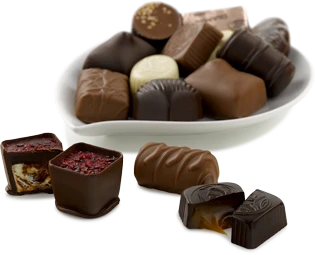
These beautifully hand-decorated pieces resemble mosaic tiles. Within
each simple cubic form is a complex taste combination of caramel,
nut, nougat, biscotti crunch and Belgian chocolate. The shells are
very thin, and the fillings are dazzling. Little windows in the cover
of each gift box reveal a sneak preview of these artistic confections.
Enjoy the 8 delicious flavors:
- Almond Crunch

- Apple Caramel
- Caramel Crunch
- Dark Cream
- Hazelnut Crunch
- Orange Crunch
- Pecan Caramel
- Rum Caramel
Who is Antoine LeBlanc?
Why
of course, he is none other than one of nine known Albino Alligators,
and he has become quite a celeb! Antoine (I love his name
it
goes well with Jude, don't you think.) travels around to be exhibited
at Zoos. Last year when he was at the San Francisco Zoo, Joseph created
this life-sized masterpiece in honor of Antoine's extraordinary beauty.
I can honestly say I would love to nibble on an alligator's leg!
The people who came to see both of the Antoines could also purchase
personal sized Chocolate Antoines, and the proceeds were donated to
the San Francisco Zoo. Besides being an awesome chocolate sculptor,
Joseph Schmidt is generous man as well who enjoys his life thoroughly.
Antoine LeBlanc is pure white with bright skyblue eyes. And most
of the time, he holds court at the New Orleans' Audubon Zoo with his
two other white buddies, Hannan and Shulte. These guys are Leucistic,
like white tigers
they have pigmented eyes, but no pigment in
their skin. Actually Leucism is quite rare. Usually albino animals
and humans are completely white, but the tiny visible blood vessels
in each iris make their eyes look pinkish yellow.
These Bad Boys inherited a genetic mutation of a protein called tyrosine.
This protein helps to manufacture melanin (the pigment that gives
color to skin). Their parents may have looked like regular old alligators,
but both parents would have needed to carry a recessive gene for that
trait.
Of course Antoine and his friends need to wear lots of sun screen,
and they really stand out for predators in the wild
does any
other animal besides humans really eat alligators? But for Antoine
Blanc and his buddies this defect pays the rent on an enormously royal
suite, and their outrageously popularity has enabled them to travel
the world to boot!
Along
with earning the reputation as the "Rodin of Chocolate"
and achieving local celebrity status, Joseph has received many awards
and numerous acknowledgments within the industry.
- 1992 Awarded the Antonin Careme Medal from the Western Chefs Association
- 1993 Distinguished Visiting Chef at Johnson & Wales University
- 1993 Honored with membership in the Honorable Order of the Golden
Torque
- 1993 Honored with membership of the Chaine Des Rotisseurs
- 1994 Honored by the California State Senate with a Certificate
of Recognition June 5,1994 designated as Joseph Schmidt Day in California
- 1996 Honorary Degree from Johnson & Wales University, Doctor
of Culinary Arts, Honoris Causa
Special commissions have included...
- The Eiffel Tower for the French Ambassador
- A 25 pound cable car for the Queen of England
- White dove for Nelson Mandela
- Giant panda for Prince Philip and the World Wildlife Organization
- Chocolate California state bear for a banquet hosted by then-Governor
Pete Wilson
- An anniversary present for President Reagan commissioned by Nancy
Reagan
- Gift for Mikhail Gorbachev
- Chocolate pandas for Mayor Feinstein's trip to China
His largest creation to date was in 1992 when he designed a Christmas
exhibit entitled the "Chocolate Celebration," filling 14,000
feet in the lobby of One Market Plaza, San Francisco. The project
consisted of 14 different themes using 10,000 lbs. of chocolate. Included
in the exhibit was a full-sized chocolate table with a Christmas feast,
a skillfully decorated 3-1/2 foot chocolate tree, a Victorian side
table complete with top hat, gloves and cane (all in chocolate), a
Dresden toy chest overflowing with toy sculptures, an alpine village,
and a 12 foot high pear tree. Joseph completed the massive display
in less than three months!
Photographs of his work have adorned the cover of Manufacturing Confectioner
eight times. His work has also been covered in numerous newspapers
and magazines including the Denver Post, Chicago Tribune, New York
Times, San Diego Sun Times, San Francisco Examiner, Toronto Star,
Japanese magazines Pronto and Axis, German travel magazines, and the
Italian Confectioner to name but a few.
Each chocolate color is applied in reverse to the mold and allowed
to harden before the next color is added
Joseph has been a constant source of human interest stories for the television media. CNN has covered him five times Internationally, and every month there is a local comment or profile on network programming that reaches large audiences.

Humming bird and flowers on Joseph's tree
His early experiments with bowls also gave him the opportunity to
discover the malleable qualities of chocolate. "Chocolate is
the most fun material in the food industries," he says. "It
gets soft quickly, you play with it, and in a few minutes, it's hard
as a rock."
Joseph
must have had fun creating Mickey for Disney. I certainly hope all
of these sculptures get eaten, since they are all made with the best
of Belgium chocolate!
Like a kid turned loose in a chocolate factory, Schmidt lets his
imagination soar. He demonstrates his true artistry through the amazing
detail in
inspiration begs for his development into new horizons of the chocolate
world.
European truffle is basically a lump of chocolate with cocoa modeled
after the French mushroom truffle, says Audrey. Joseph decided that
the American public would accept a different look.
"Americans say, 'Show me something beautiful and I'll try it.'
I figured an egg would be a very natural, elegant shape."
"We didn't have any packaging for the new truffles so Joseph
started developing these wonderful bowls out of chocolate," says
Ryan. Working with dark, milk, and white chocolates and food dyes,
Schmidt created colorful lotus-flower shaped bowls that were as smooth
and delicate as porcelain.
Stunning, intriguing and meticulously crafted
his edible bowls
stopped shoppers in their tracks!
Audrey Ryan has been equally busy designing and handcrafted packaging.
One reason they decided to create special packaging was some of the
delicate chocolate designs were not shipping well.
Today Ryan's hand-made, hand-painted boxes, produced in India, the
Philippines and Mexico, are as sought after as the candies inside.
Here again, they both broke away from European chocolate traditions.
Audrey Ryan is often asked to autograph the boxes
they are
becoming collectibles!
Joseph Schmidt was born in 1939, in Jerusalem to Viennese parents.
His career began as an apprentice aboard the Zimline passenger ship
line, where he trained with European chefs, and developed his natural
talent for the confectionery side of culinary arts.
With a yearning for travel and discovery, he immigrated to the United
States in his early 20's. More training at a Manhattan pastry shop
lasted for six years. Then Joseph gave in to his Wanderlust and he
found himself visiting San Francisco, now his hometown.
While working at Fantasia Confections for 11 years he met his future partner, Audrey Ryan. Her European training in confections and chocolate provided a foundation for them to develop their own business.
What about white chocolate?White Chocolate is an Aberration like Moby Dick and Antoine LeBlanc
After World War I, White Chocolate was introduced by the Swiss. It
is more expensive to produce than dark chocolate since it contains
much more cocoa butter. The cocoa butter gives White Chocolate a subtle
hint of chocolaty taste. It is combined with sugar, butterfat, milk
solids, lecithin and other flavorings. It contains no chocolate liquor
and gets its ivory color from the cocoa butter.
According to FDA standards, real chocolate must contain chocolate
liquor (the solid that results from finely grinding cocoa bean nibs).
For years, The U.S. barred manufacturers from calling this product
"chocolate" as it is called in Europe, and so it may be
labeled confectionery coating or summer coating. If the "white
chocolate" looks bright white, not ivory, it probably doesn't
contain cocoa butter. They may have substituted a mixture of other
vegetable fat.
To make white chocolate, chocolate liquor is pumped into hydraulic
presses weighing up to 25 tons, and when the pressure is applied,
about 80% of the cocoa butter is removed. The fat drains away through
metallic screens as a yellow liquid, and then is collected for use
in chocolate manufacturing. Cocoa butter, unique among vegetable fats,
is a solid at normal room temperature and melts at 89 to 93 °F
just below body temperature.
Q Where does Chocolate come from, Jude? Is it true that it
grows on trees?!
A You bet it does!! The cocoa tree grows in tropical climates
where it is consistently warm and very humid. Cocoa beans, which are
the main ingredient of chocolate, are seeds found within the cocoa
tree's fruit pods. After harvest, the cocoa beans are first fermented,
then dried, then roasted or grilled, and finally cleaned and ground
down before the cocoa liquor is extracted. Gary, for a more detailed
description of this cultivation of cocoa tress and process of creating
chocolate, see ChocolateBytes. And Time Line
it's a fascinating
and succinct history of chocolate, covering over 3000 years!