Past
Newsletters
Vol 3 No 12
In Pursuit of Chocolate
Ooh La! La! - First Class Indulgence
In
Pursuit of Chocolate wishes you and yours a prosperous holiday season,
and may chocolate always be a welcome addition to your winter festivities!
From the farthest corners of the world, the folks at Zingerman’s
have outdone themselves once again with a tantalizing selection from
Pierre Koenig. Our selection this month will surely push the limits
of your chocolate indulgence meter - as if there were limits!
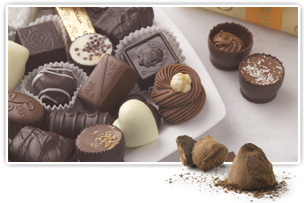
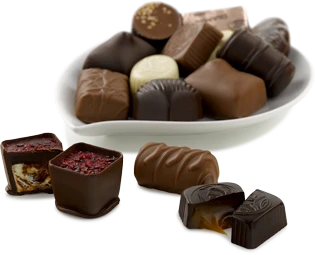
Pierre Koenig sends you the same fine collection that is sold at his shops in France. Pierre’s incredible chocolates are sold in some of the most exclusive gourmet food stores throughout Europe, including Hediard, Fauchon, and Air France First Class. This collection contains some Truffles, but it is comprised mainly of his other signature creations.
A Delicate Blend Of Ingredients - And Passion
In
the heart of the Lorraine region of France, Pierre Koenig, a master
chef of chocolate confections carries on the tradition of his father
and grandfather. Koenig owes his worldwide reputation to his artistic
interpretation of the finest ingredients, a masterful know-how, the
delicacy of his marvelous chocolate sweets, and to the unfailing rigor
that governs their creation. An exceptional blend of the fruity, full-bodied
flavor of the Criollo beans of Ecuador, Trinitario beans from South-East
Asia and Forastero beans from the Amazon gives his chocolates a distinctive
taste.
Koenig’s fillings are made from some of the most precious fruits, almonds from Valencia’s red lands in Spain, hazelnuts from Piemont in Italy, pistachios from Turkey, and generous butter and cream from Normandy, France… nothing is too fine for the gourmands’ delicate palates. Close your eyes and savor the extraordinary nuances of each delicately crafted chocolate… you may even be able to visualize the vibrant terrain of France.
In A Class Of Distinction
One may wonder why Pierre and other French masters claim their chocolates to be unique. Unlike the chocolates of Belgium and the US, Les Grand Chocolats are noted for their intense and passionate flavors derived from unique blends of cocoa beans and roasting methods… resulting in rich, deep, and very dark chocolate couverture. The chocolatiers of Belgium and Switzerland are more inclined to use a gentle milk chocolate couverture to fashion their sweets. Belgium is also noted for the splendid fresh creams that distinguish their chocolates from the others.
Pierre prefers to blend a very dark couveture with stronger flavors such as coffee, ground nuts, pralines and liquors, and Koenig infuses his truffles with double-rich, extra dark, sweet ganaches (a mixture of cream, chocolate, butter and flavorings). Perhaps one or two pieces may satisfy your craving, rather than indulging in many pieces with a slight sweet butter cream center.
And Now, An Overture For Couverture
Couverture is a term describing professional-quality coating chocolate that is extremely glossy. It usually contains a minimum of 32% cocoa butter, which enables it to form a much thinner shell than ordinary confectionary coating. Couverture is usually only found in specialty candy-making shops. You often find it as the chocolate that surrounds chocolate-covered fruits, or as the shell of fancy filled chocolates.
From the tree to the Confectioner
The
intoxicating flavors that explode in your mouth are created with an
intricate series of steps that add to the dynamics of perfect chocolate.
Once the cocoa beans arrive at the factory, they go through a sieve
in order to get rid of any impurity. Then they are roasted for 25
to 50 minutes at a temperature of 110-150°C.
During this process a cocoa specialist’s (a vital role) years of expertise and intuition are indispensable, since he or she must determine the exact roasting time which allows the cocoa beans to develop the best aroma. Each batch of beans is unique, depending on the mixture, when and where they were harvested, the humidity, and the like. Not a job for a narcoleptic! When the roasting time is too short, the humidity percent is too high, but when it is too long, the cocoa beans can be carbonized! And you can kiss your holiday bonus good bye.
The beans are then cooled off by ventilation. Once they have cooled down, they are crushed, and then ground into a cocoa paste. This paste will be homogenized, brought to a temperature of about 110°C and then passed through a hydraulic press which extracts cocoa butter… a precious product that will be used in the chocolate preparation.
The cocoa paste, cleared of the greatest part of the cocoa butter (there is always some left behind) looks like solid chocolate loaves. In France they are called "tourteau." These tourteau are then crushed and pulverized in order to obtain cocoa powder.
Chocolate
is a mixture of cocoa powder (which still has a proportion of fat),
cocoa butter (which has been further processed), sugar, and depending
on the variety, milk and various ingredients such as hazelnuts, almonds,
etc. When the composition is chosen, the mixture is kneaded in a mixer
until homogeneous. The mass has a determined fluidity. At this moment
its taste is pleasant, but it is still granulous.
Next the mixture is refined by a rolling wheel, in a “refiner-crusher machine. After this process, the mixture looks like a thin, solid film. Are we there yet? Nope, there is yet one more step, "conching" - often considered the most important, by everyone except the cocoa roasting specialist, and the expert who chooses the beans at the Cocoa Exchange.
A Conching We Will Go
Conching is what gives the chocolate its subtlety and its smoothness. The conching machines knead the chocolate paste during controlled temperatures. This process develops flavors and changes the texture. It’s the last and most important refining process, which allows the separate flavors of the individual ingredients to combine, and eliminates the last volatile acids.
Conches (the paddles of the early machines resembled conch shells) are equipped with heavy rollers that plow back and forth through the chocolate paste, anywhere from a few hours to several days. Contemporary technologies can grind the chocolate particles extremely fine, which can reduce conching times. Swiss and Belgian chocolates are conched as much as 96 hours. Some chocolates are not conched at all, or for only 4 to 12 hours. Now can we make a chocolate bar? Nope.
Now the velvety chocolate must be tempered. When chocolate is tempered it has a shiny, even appearance and smooth texture. It breaks with a sharp snap, sets up rapidly, and releases easily from molds. All chocolate comes from the manufacturer tempered, but when it is melted it loses the temper and must be tempered again for dipping and molding. To temper chocolate, it is heated so it melts completely, stirred to cool to approximately 78 degrees Fahrenheit, then heated again to an exact temperature, depending on the type of chocolate it is dark, milk, or white.
Magic Beans
Cacao
trees belong to the family Sterculiaceae. The common cacao tree is
classified as Theobroma cacao. Having a very delicate and sensitive
nature, the cacao tree needs protection from wind and requires a fair
amount of shade, especially in its first four years of growth. With
pruning and careful cultivation, the trees of most strains will begin
bearing fruit in their fifth year.
A perennial that yields several harvests annually, Cacao trees were
first cultivated in South America, then introduced to Europe during
the 16th century, and today, grown chiefly in western Africa. The
average cacao tree attains a height of about 20 feet, has shiny leaves
as long as 12 inches, and small pink flowers on the trunk and older
branches. Only about 30 of the 6000 annual blossoms per tree eventually
bear seeds. Commonly called cocoa beans, the seeds are surrounded
by a yellow or reddish-brown pod up to 12 inches long. Cocoa beans,
found inside the pods, are either purple or off-white and resemble
almonds.
In the world of chocolate production there are three main varieties
of cocoa trees. Criollo trees, primarily cultivated in Central America,
provide 5 to 10 % of the total production. The cocoas obtained from
Criollo beans are the finest, but diseases can easily hit these trees.
Forastero trees account for over 70% of the total production. They are cultivated in Western Africa, Brazil, and Ecuador. The newest variety, the Trinitario tree, is grown in many parts of the world, near the Equator. This variety is a cross between the first two species. Trinitario trees took their parents best qualities. Not only does it provide fine cocoa, it also has a good resistance to diseases. Trinitarios are expected to flourish over time, but currently they produce only 20 % of the global production.
The beans are sold in international markets. African countries harvest about 2/3 of the total world output - Ghana, Côte d'Ivoire, Nigeria, and Cameroon are the leading African cocoa producers. Most of the remainder comes from South American countries, mainly Brazil and Ecuador.
Want To Know More? Check out our website http://www.chocolatemonthclub.com/factory.htm.
"The Cathedral Town
Pierre Koenig’s artistry began in Metz, in the heart of Lorraine, close to the German and Luxembourg borders. This region is renowned for its people’s diligence and perfectionism. Here in Metz, you will discover some of the finest chocolates in the world.
The region of Lorraine, closely associated with its neighbor Alsace, consists of the Meuse, Meurthe et Moselle, Moselle and Vosges. The Lorraine landscape offers scenic vistas of the Vosges, a mountain range that spreads into the Franche-Comté and Champagne region. Although a largely industrious region, Lorraine is still home to many unspoiled areas of beauty, with over 1/3rd of the land forested, quaint stucco villages, lush fruitful vineyards and orchards.
Metz, named after the Gallic tribe Mediomatrici who once lived there, has undergone numerous transitions over the centuries. Today it is one of eight French cities targeted by the government for special planning and development. It is home to one of the finest Gothic cathedrals in France, the Cathédrale St- Étienne, where the Marc Chagall stained glass windows shimmer through the sunlight.
Nearby you can visit Nancy, one of France's most sophisticated towns. Nancy, in Meurthe-et-Moselle boasts one of the country's finest examples of Rocco architecture in the Stanislas Square, named after the Polish King Stanislas Leszcynski. Nancy is made up of two fortified towns, the Ville-Vielle (Old Town) and the Ville-Neuve (New town), which were formed during the 16th Century.
During the early 20th Century, Nancy rivaled Paris as a center of Art nouveau, with a steep tradition in handicraft and artwork. Émile Gallé, manufacturer of French art glass and ceramics, was one of the pioneers of Art Nouveau.