Past
Newsletters
Vol 2 No 9
In Pursuit of Chocolate
Founded On A Dare
Sometimes necessity gives birth to great things. And
so it was with the creation of Vermonts Lake Chaplain Chocolate
Company, which boasts several awards, some from elite epicurean institutions.
The best in the country, says the New York Times.
Lake Champlain Chocolates was founded in 1983 on a dare. The owner
of Burlington's acclaimed Ice House Restaurant, Jim Lampman, used
to buy expensive boxes of chocolates as gifts for his staff. One day,
his pastry chef, a man of impeccable culinary taste, took him aside
after receiving one too many boxes. "These chocolates are terrible,
he confessed. "All right, you do better! Jim challenged.
Shortly thereafter, he was presented with the finest chocolates he
had ever tasted! And the Ice House Restaurant began serving hand-rolled,
distinctively flavored truffles to their appreciative restaurant patrons.
The response was so unbelievably overwhelming! There was nothing left
to do but found an upscale confection business. Although their products
were intended only for wholesale customers, and the business was located
in a little alley, somehow retail customers found them and began knocking
on the door. Word of mouth about the heavenly chocolates spread like
wildfire and eventually, Jim sold his restaurant to devote full attention
to his new business.
Today, the growing team of 80 continues to uphold the highest standards
of chocolate making. Of course they use the freshest ingredients and
the very best chocolate, but what truly sets them apart is their heritage
of fine craftsmanship and creativity
and the wonderful flavors
of Vermont. There are no preservatives, extenders or additives in
Lake Champlain Chocolates. All of their chocolates are made in small
batches to ensure exceptional freshness. The chocolate factory is
located on the inspirational and often breathtaking shores of Lake
Champlain. There is nothing quite as awe inspiring as the fall pageant
of colors and smells
the lake is quiet and the eerie calls of
loons bring forth a peaceful feeling. And personally, some of my most
treasured moments were spent in absolute quiet, watching snow fall
on the lake. In the Green Mountain state of Vermont, people experience
all of the Earths seasons
and celebrate them with fine,
fresh foods. The pleasure and creativity that Jim and his employees
find in this way of life is truly inherent in these delicious chocolates.
Top Choice, Favorite, Outstanding, The Ultimate
In 2000, Lake Champlain Chocolates was awarded the prestigious Epicurean
Award for Top Choice Chocolates by the American Institute of Wine
& Food.
In 1998 Lake Champlain Chocolates' Hazelnut Five Star Bar won the
"Outstanding Confection" award by the National Association
for the Specialty Food Trade at the annual summer International Fancy
Food Show in New York City.
The Five Star Bar line was a finalist in this same competition in
1996 and voted Best New Bar of 1989 by the Candy Bar Gazebo. It was
also named The Ultimate Chocolate Bar by Vogue Magazine in 1993 and
1990
prestigious accolades for any Chocolatier.
Other awards reflect the wide range of quality and workmanship in
every facet of their chocolate making process: the Burlington Free
Press Reader's Choice Awards in 1999 (and consecutively since 1993);
Lake Champlain Chocolates was voted "Favorite Chocolate"
by the Albany, NY Times Union newspaper in 1999; and their chocolate
factory was selected as the "Editor's Pick" for an outstanding
reason to visit New England by Yankee Magazine's Travel Guide in 1999.
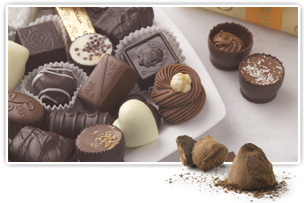
Chocolates of Vermont is the signature line of Lake Champlain Chocolates
and so it is with pride that we bring you these sumptuous blends of
chocolate that impress the palates of even the most particular gourmands.
Handcrafted from the highest quality Belgian chocolate and the finest
natural ingredients including local Vermont cream, sweet butter, maple
syrup, honey, fruits, nuts, and natural flavorings
this chocolate
represents the memorable moods and flavorings of Vermont.
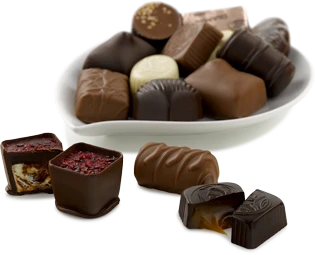
- Maple Crunch: Maple leaf-embossed dark chocolate with a buttery Vermont maple syrup toffee center.
- Green Mountain: Roasted almonds, dried fruit and smooth milk chocolate sculpted into a majestic mountain.
- Honey Caramel: A beehive with wildflowers decorates creamy caramel, laced with Vermont honey and tucked into dark chocolate.
- Evergreen Mint: A miniature moonlit Lake Champlain scene molded of bittersweet chocolate with a crisp peppermint crunch.
We
have also included one of my favorites, the Java Truffle Bar: a robust
coffee infused ganache tucked inside decadent dark chocolate
just what I want after a good meal. And we thought you would enjoy
a brand new confection that was just introduced in July and is already
receiving raves from loyal patrons! The Raspberry Truffle Bar is Belgian
dark chocolate with a luscious raspberry truffle filling. Each bar
weighs 3.25 oz. and is crafted from Callebaut chocolate, a very rich
tasting Belgian chocolate that absolutely melts in your mouth. This
combined with all natural ingredients makes for an extraordinary tasting
sweet, made on the shores of Lake Champlain, from Jims family
to yours.
This Story Begins With Magic Beans
One of the greatest troves ever discovered was the bean of the cacao tree. Known in scientific circles as Theobroma cacao, it is the one and only source of chocolate. Silky in texture, beautifully concentrated in taste, slightly perfumed and exquisite to behold, chocolate is a bountiful source of enjoyment, adored by almost everyone.
Translated from Greek, Theobroma cacao literally means food
of the gods. As such, it has been the subject of worship, obsession
and addiction down through the ages, and holds no less power today
then it did when it was first discovered in the ancient land of the
Maya. The cacao tree grows close to the equator and thrives on very
high temperatures and humidity. The trees bare oval fruits, or pods,
which are about 5-12 inches long. Each fruit will hold up to 24-40
seeds and the world has come to know these seeds as cocoa beans.
The colorful ripening pods hang from the trunk and largest branches
on very small stems and are harvested all throughout the year. They
are chopped off the tree with a cutlass, opened and the seeds are
removed. This part of the process is extremely important. It takes
years of practice and knowledge to be absolutely certain that the
pods are ripe. This is why experienced pickers are extremely valuable.
When the seeds are ripe, each seed, or cocoa bean, is about the size
of an olive. The world was created in seven days, but chocolate takes
longer. The cream-colored beans immediately turn a purplish color
when exposed to light. At this point they are ready for fermentation,
so they are heaped in conical piles on the ground and covered with
banana leaves. During the 2-9 days of fermentation, the beans begin
to take on color and flavor.
The actual enzymatic process that takes place at this point can be
very complex, but basically the sugary pulp surrounding the beans
goes through chemical changes, causing the temperature of the heap
to rise. It is under these conditions that dramatic changes in the
cocoa bean take place. The color changes from purple to chocolate
brown and the familiar cacao smell begins to emerge. Fermentation
is a crucial stage in developing beans of superior quality. The beans
must be painstakingly dried. They are placed on wooden boards or bamboo
mats for up to 14 days under the hot sun, and they must be continually
turned over to prevent molds from forming. When they are thoroughly
dry, they are packed into sacks and checked for quality. Now they
are ready to be shipped and traded on the global market.
Youve got to taste a lot of beans to develop skill as a Chocolatier. Blending of the beans for cocoa powder is, for the most part, less critical than for eating chocolate. The ability to discern the distinctive flavors imparted by different varieties of beans is only acquired by years of experience. Not only do the varietal and the process impact the taste, but also the location where the beans are grown. Each blend of cacao beans is virtually unique depending on all of these variables.
The next step is a vital process in which the flavor of the chocolate
is developed and mellowed, any residual bitterness is removed, and
the texture reaches that essential stage of velvety smoothness. The
process called conching was invented by Swiss Chocolatier
Rodolphe Lindt in 1880. The name is French (conche, meaning shell)
and the process was called conching because of the shape of the early
machines, which were large shell-shaped containers.
Conching is a precise process of rolling, kneading, heating
and aeration. The machine agitates the liquid gently over a period
that may be as long as seven days. Usually the longer the conching
process, the higher the quality and so it is here that gourmet Chocolatiers
will define the final aroma and flavor of their chocolates. The chocolate
is now ready for final processing. To be delivered to Lake Champlain
Chocolates, or any other chocolate factory, it must be tempered. The
chocolate is fed into tempering kettles, where it is stirred continually
and carefully cooled. At this stage it is still liquid. Tempering
is not an easy process, since cacao butter contains different types
of fat, all with different melting and setting points. If the chocolate
mass is cooled too slowly, some fats will remain liquid and separate
from the mass, creating a bloom on the surface when the chocolate
finally solidifies. Tempering causes rapid cooling, resulting in a
more even distribution of the various fats. During this process, the
cocoa butter reaches its most stable form, and this gives fine chocolate
its snap, shiny surface, and smoothness. With this last
part of the process complete, the specialty chocolate maker can now
give full rein to his artistry and make the creations that cause our
mouths to water and senses to tingle.
Tasting Notes
- Chocolate is best tasted on an empty stomach. The proper temperature of the chocolate should be between 66 and 77 degrees. Never put your chocolate in the refrigerator it will cause the cacao to separate and form a white bloom.
- If you are trying several different chocolates, always start with the one that has the least cacao, probably a milk chocolate unless of course its white chocolate, which has no cacao at all.
- When tasting dark chocolate, let the chocolate sit in your mouth for a few seconds to release its primary flavors and aromas. Then chew it 5-10 times to release the secondary aromas. Let it rest lightly against the roof of your mouth so you experience the full range of flavors. Finally, enjoy the lingering taste in your mouth. Discovered by Samuel de Champlain Vermont is a tiny state hidden in the northeast corner of the United States. Originally populated by various indigenous peoples of the Algonquin, Iroquois, and Abenaki nations. The land now known as Vermont was first seen by European eyes in 1609, when the French explorer Samuel de Champlain sailed the lake that now bears his name. The French must have paid their visits during the warmer months, for when they gazed upon the mountains that form the spine of the state, they named them Les verts monts, 17th Century French for green mountains what Champlain lacked in creativity, he made up for as an explorer. Champlain claimed all he saw in the name of France. The sides and, in most cases, the summits of the mountains are covered with evergreens, such as spruce, hemlock and fir.
The name of state capital "Montpelier" also comes from the French Montpelier, which means the "naked mount." As happens with language, Les verts monts became Verts Mont, and finally Vermont.
In 1763, England was granted the area via the Treaty of Paris, which ended the French and Indian war. Locally, the land was at various times claimed by both New Hampshire and New York, until Ethan Allen remained an independent republic until 1789. To this day Vermonters remain fiercely independent in spirit.