The Gourmet Chocolate of the Month Club

Past Newsletters
Vol 2 No 10

In Pursuit of Chocolate

Vosges Haut Chocolat

Confections Out of this World

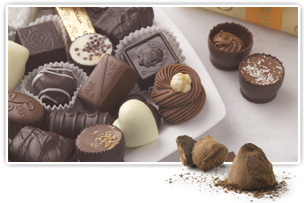
This month we travel the world through the sweet delights of Vosges Haut Chocolat, a company founded on a love of international taste and exotic flavorings. Our delectable selection for this month includes a collection of unique and tantalizing truffles made from the finest ingredients found only in select gourmet houses around the world. With each indulgence in these chocolates, we know you're sure to experience the rich heritage of spices, flowers and liqueurs that Vosges (pronounced vozh) is renowned for. Every ingredient is personally selected by Le Cordon Bleu alumna and co-founder Katrina Markoff and her delicate attention to detail and worldly education has resulted in confectionaries that are simply unrivaled.

A Trove of Distinctive Truffles

Vosges truffles, inspired by Katrina's global culinary apprenticeships have the exotic influences of an "East meets West" theme. The infusions of rare spices and flowers combined with premium chocolate give a finely tuned balance of flavor allowing you to experience the best tasting truffle in the world.

The first selection is the Tlan Nacu truffle, the name literally meaning "good heart". The moniker originated from the name of a small vanilla bean plantation in the town of Papantla on the Gulf Coast of Mexico. These plump vanilla beans are infused in warm cream imparting a very distinct Mexican vanilla flavor. Made with Belgian dark chocolate and hand picked vanilla beans, this sumptuous truffle is simply enchanting and one we couldn't resist bringing to you!

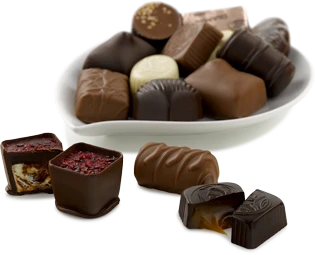
Next is a selection of internationally flavored truffles that will indulge you in tastes from all over the world. Once you set your sights and palates on these colorful jewels of chocolate, their stories will begin, telling of luxurious chocolate infused with exotic spices, flowers and liqueurs, conjuring pictures of the rich, cultural heritage from which they were created. Included in this enticing collection....

Black Pearl... A taste of Japan! Ginger and wasabi infuse fresh cream and premium dark chocolate. Each truffle is dipped in rich chocolate and sprinkled with black sesame seeds.

Absinthe... Reminiscent of the fashionable French cocktail of the late 1800's, this truffle is based on the flavors of aniseed. The finest dark chocolate is infused with fennel, a splash of Pastis, and a sprinkle of Chinese star anise. We present this truffle in remembrance of this infamous drink.

Wink of the Rabbit... Inspired by the timeless tale of the tortoise and the hare, Vosges celebrates the triumphant victory of the turtle that won the race 'in a wink.' Creamy Belgian milk chocolate surrounds a soft caramel center, dipped in milk chocolate and topped with toasted Georgian pecans. Never underestimate a turtle.

Ambrosia... Food for the gods! Our cocoa butter based white chocolate is accented with a splash of Cointreau and topped with roasted Australian macadamia nuts. Athena would be jealous.

Naga... Named after a tribe in Northeast India, we've combined natural coconut extract, milk chocolate, and a pinch of fragrant curry powder. Dipped in milk chocolate and finished with a sprinkling of Northern Indian curry, this truffle creates a beautiful balance in spiciness, sweetness and color. A must try for the adventurous sort!

Budapest... Influences from Hungary bring about this dark chocolate truffle. A combination of Belgian dark chocolate and fresh cream is finished with a dusting of sweet Hungarian paprika. The perfect complement to a spicy Cuban cigar.

Woolloomooloo... A famous area in Sydney inspires this Aussie claim. Macadamia nuts, native to Australia, were the first Australian trees to be developed as a food crop. In honor of Australia's claim to the macadamia nut, we have named this truffle Woolloomooloo. A mélange of milk chocolate and macadamia nut praline topped with fresh coconut.

Chef Pascal... Named after the famous pastry chef at Le Cordon Bleu in Paris, who loved to use 'un peu plus de Kirsch,' this truffle is sheer heaven. Premium dark chocolate is placed in a mélange of fresh cream, Kirsch and crowned with a cherry. There is no such thing as too much of a good thing!

Gianduia... Italy's invention of a 'dolce' heaven. A mixture of velvety milk chocolate and crunchy praline dipped in chocolate and sprinkled with praline pieces. Bon Appétito!

Artistry de Chocolat and the French Tradition of Le Cordon Bleu

The name Le Cordon Bleu has been synonymous with culinary excellence since the 19th century. When King Henry III created one of the most important orders in France, "L'Ordre du Saint-Esprit," "The Order of the Holy Spirit," in 1578 knights of this order were named 'Cordon Bleu' because of the blue ribbon they wore on which hung the cross of the Holy Spirit. The feasts accompanying their ceremonies became legendary and so was spawned a culinary educational facility that is world-renowned.

Katrina Markoff, Vosges chocolatier, utilizes the original methods of French confectionery artistry, having graduated with the Grand Diplome from Le Cordon Bleu in Paris and worked extensively in France and Spain. Some of her experiences include apprenticeships with pastry chef Christophe Felder at the Hotel Crillon in Paris and Fernando Adria at El Bulli in Spain. She continued her studies in Europe, Asia, and Australia graduating from various culinary schools including The Oriental Cooking School in Bangkok. During Katrina's studies at Le Cordon Bleu in Paris, she fell in love with the cuisine of the Michelin three star restaurant, L'Ambroisie. L'Ambroisie resides within the square of the distinguished, red building facades that make up the Place des Vosges. In addition, Vosges is a 'Haut' mountain range in Alsace. Thus, the inspiration for the name, Vosges Haut-Chocolat.

Katrina Markoff co-founded the company with Julie Lang. As grade school friends and past business partners, Katrina and Julie embarked once again on another adventure. Julie Lang, who is responsible for Vosges outside of the kitchen, spent time after graduation studying the import and export industry while living in Costa Rica. There she was impressed with the unique culture and indigenous flavors of the Central American land. Living on one of the most exclusive coffee plantations in Costa Rica, Finca Quirazu, she learned a great deal about the coffee industry. The knowledge gained from Lang's exposure to Central American food products contributes in determining which new flavor combinations meet the "exotic" standards of Vosges. With all of this said, Katrina and Julie's customers are ensured that each truffle experience is another exciting adventure of the Vosges journey.

Chocolate Travels the World

During the 16th Century, chocolate began its journey into the countries of Europe as colonists exploited their new world discoveries. Reaching Spain first, then following trade routes to Northern Europe and Great Britain, chocolate eventually made its way back across the Atlantic to North America.

The Spanish Acquisition

It was probably through merchants, and also through contact between New World convents and monasteries and their Spanish counterpart, that chocolate found its way to Spain.

Once the first commercial cargo of cacao beans from Veracruz had been unloaded in 1585 and the official trade routes established, chocolate quickly became part of the Spanish way of life, especially among society's elite. However, a French noblewoman visiting Spain was unimpressed. She said of the drink: "They take it with so much pepper and so many spices, that it is impossible they don't burn themselves up." Nor was she impressed by their dental care and personal habits: "Their teeth are good, and would be white if they took care of them, but they neglect them. Besides the sugar and the chocolate which spoil them, they have the bad habit, men and women alike, of cleaning them with a toothpick, in whatever company they are."

Italy Indulges in the New Drink

There are conflicting theories as to how and when chocolate reached Italy. Some historians believe it was around the middle of the sixteenth century when the exiled duke Emmanuel-Philibert returned to power, having experienced the delights of chocolate in Spain. The popular theory is that chocolate was imported by a Florentine merchant, Antonio Carletti, who discovered it while traveling the world in search of new products to sell. The most likely theory is that chocolate was brought in as a medicine through the convents and monasteries.

By the seventeenth century, a growing number of chocolate companies had become established in northern Italy, particularly around the towns of Perugia and Turin. These companies in turn began to export their newly developed products to other European countries.

The French Toast to Cacao

France was also quick to fall under chocolate's spell. As with Spain and Italy, there are conflicting theories about the circumstances surrounding its first appearance. However, there is also no doubt that the trend was largely set by nobility and the royal court as it was in other European countries.

The most popular theory is that the drink made its first appearance in 1615 when Louis XIII married Anne of Austria, the young daughter of Philip II of Spain. The new queen loved her chocolate with a passion and introduced it to members of the court. There were plenty of devotees: The king's personal adviser, the formidable Cardinal Mazarin, absolutely refused to travel anywhere without his personal chocolate-maker, and later, Marie Antoinette, also very fond of chocolate, created the prestigious "Charge of chocolate-maker of the Queen." Chocolate parties held by royalty, chocolat du roi, became a fashionable social ritual to which it was the ultimate in chic to be invited.

The many anecdotes include the story of the Spanish princess Maria Teresa, who married Louis XIV in 1660. She is said to have declared: "Chocolate and the King are my only passions." (Note the order.)

Great Scots! Great Britain Throws it Overboard

In the sixteenth century, when the Spanish were shipping cacao as if there were no tomorrow, the British could not have cared less about it. Even the pirates who plagued the Spanish ports and shipping routes seemed unaware of its economic and cultural importance, for they showed no interest in the valuable cargo. Like their Dutch counterparts, they are reputed to have thrown boatloads of it overboard in disgust.

However, the wealthy upper-class couldn't get enough of it. The diarist Samuel Pepys (1633-1703) was an ardent fan of chocolate, or "jocolatte," and a regular frequenter of the chocolate houses. One entry in his diary records a horrendous hangover the morning after the king's coronation: "Waked in the morning with my head in a sad taking through last night's drink, which I am very sorry for; so rose, and went with Mr. Creed to drink our morning draught, which he did give me in Chocolate to settle my stomache."

The States Start Their Consumption

The first chocolate found its way back across the Atlantic to North America around 1765, probably in the pockets of high-ranking English officials going to their posts in the Eastern colonies. We also know that Domingo Ghirardelli, an Italian confectioner then trading in Lima, Peru, exported cacao beans and other essential commodities from South America to San Francisco to supply the needs of the gold-rush hordes. Another possible route for cacao beans was directly from Jamaica after the Spanish had given up control there.

Thomas Jefferson (1743-1826), third president of the United States, is quoted as saying: "The superiority of chocolate, both for health and nourishment, will soon give it the preference over tea and coffee in America which it has in Spain." Because of the pioneering nature of North American society, chocolate was given a somewhat different reception than the one it had received in Europe. Although the wealthy eastern society enjoyed chocolate, they drank it at home - chocolate houses did not exist. Another difference was that chocolate was generally marketed to the masses rather than the elite (as in Europe), with the emphasis on wholesomeness rather than sophistication, so it consequently reached a far broader segment of society than it had in Spain, France and England.

From Preservation to Divination
The History of the Truffle

Did you ever wonder how someone could come up with such a scrumptious concoction as the truffle? Being that the term "truffles" has referred to underground fungi far longer than chocolate confections, one wonders how the bridge from tasty mushroom to intoxicating divinity occurred.

Mold truffles have been mentioned as far back as the Bible and have been a delicacy much sought after through the ages in many cultures. In recent years, during the Kuwait War, some Kuwaitis were more upset over the loss of truffles than they were the ransacking of their country.

With the discovery of the New World, many new foods and cooking techniques came to be. One of these was none other than chocolate, quickly becoming the rage of its day. During this same time, ground truffles were still only available to those lucky enough to find them or with the wealth to buy them. It was a very ingenious person who discovered that a truffle could be preserved for some time in either brandy or port, the liquors absorbing some of the truffle aromas, essences and esthers. Chocolate shells were then created, into which small quantities of this liquid were poured, then sealed with a bit of chocolate. Suddenly the taste and aromas of both truffles and chocolate could be enjoyed together and a new luxury for a new world came to be!


Logo
Since 1994
Home
Join our Club
Gift Memberships
Renewals
Chocolate Club Info
Club Q&A
Current Chocolate Selections
Past Club Selections
Testimonials
Other Gourmet Clubs
Corporate Gifts
Wedding Gifts
Chocolate Bytes
Chocolate Recipes
Resources
Ask Jude
Print a Gift Card
Send a Virtual Treat
Refer a Friend
Send a Hint
E-Promos
Contact Us
Link to Us

1 - 800 - 625 - 8238
(Outside US call: 949-206-1904)
P.O. Box 1627, Lake Forest, CA 9260